Annapurna Base Camp Trek 2026
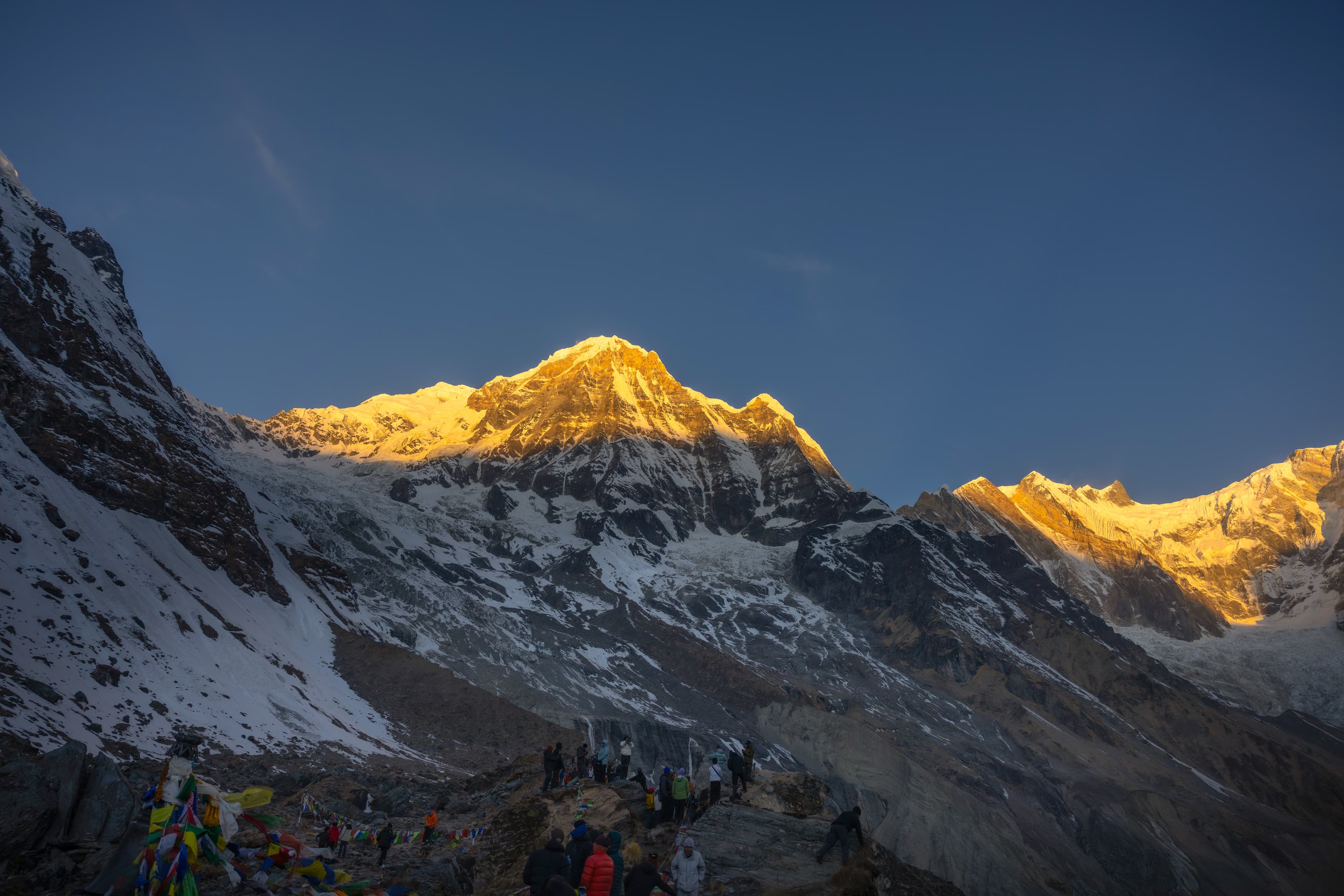
The ABC Trek offers trekkers some of the most iconic Himalayan experiences. This trek starts from Nayapul (1,070 m), via Ghorepani (2,874 m), Chhomrong (2,170 m), to Bamboo (2,310 m). Gradual climbing through forests and terraced fields with traditional villages forms a perfect balance between nature and culture.
Further, Ghorepani at 2,874 m is the gateway towards Poon Hill, a ridge at 3,210 m, with its panoramic view of sunrise across Annapurna I (8,091 m), Dhaulagiri (8,167 m), and Machhapuchhre (6,993 m); trekkers often rise early to behold golden peaks. Rhododendron forests add beauty to the springtime scene. Thus, the first viewpoints create anticipation for higher elevation.
Likewise, the trail passes through Chhomrong (2,170 m), a traditional Gurung village. Stone houses, prayer flags, and terraced farms reflect authentic Himalayan life. Local teahouses provide meals and warm rooms. The cultural interaction deepens the understanding of the regional traditions.
Similarly, the hike goes up to Bamboo (2,310 m) and Deurali (3,230 m), and the forests gradually become alpine. Oaks and rhododendrons yield to rocky slopes. Annapurna South (7,219 m) and Hiunchuli (6,441 m) come into full view. Changing landscapes continue to provide variety and trekking motivation.
Consequently, views of the Machhapuchhre massif (6,993 meters) are seen panoramically from Machhapuchhre Base Camp (3,700 meters). Trekkers will also see glaciers and cascading ridges. The open alpine terrain allows views, photography, and relaxation. The base camp is not as crowded as ABC itself.
Further, the ultimate reward of the journey is Annapurna Base Camp at 4,130 meters. The amphitheater of peaks comprises the Annapurna I-8,091 m, Annapurna South-7,219 m, Hiunchuli-6,441 m, and Machhapuchhre-6,993 m. Sunrise and sunset offer spectacular lighting over the peaks. A sense of achievement at this elevation creates lifelong memories.
Additionally, on the ABC trek, accommodation remains simple but adequate. Teahouses offer warm rooms, meals, and charging facilities. Dal bhat, noodle soups, pancakes, and tea remain standard. The fact that services are consistent supports trekking safety and comfort.
Acclimatization is thus necessary to avoid altitude sickness at higher points such as Deurali (3,230 m) and ABC (4,130 m); trekkers often spend extra days at Landruk (1,565 m) or Chhomrong (2,170 m) for the purpose of acclimatization. Proper pacing provides much safer ascents. Thus, the trek balances challenge with accessibility in an ideal way.
Similarly, the hike needs permits: ACAP and TIMS. These can be issued in Pokhara (822 m) or Kathmandu (1,400 m). Fees ensure various conservation efforts in the Annapurna region. The formalities for permission are smooth and clear.
Additionally, the best seasons for trekking are autumn, ranging from September to November, and spring, which includes the months from March through May. One gets to see clear skies with moderate temperatures and good mountain views. The nights get cold during winter, while the monsoon brings slippery trails. Seasonal planning guarantees both safety and enjoyment. Apart from the scenery and culture, the cost of the trek ranges from USD 600-1,200 for guided packages. This typically covers the provision of accommodation, meals, guide, porter, and permits. Additional costs may apply for charging, Wi-Fi, and hot showers. Finally, the Annapurna Base Camp Trek 2026 offers a perfect combination of Himalayan scenery, cultural villages, and trekking adventure. Majestic peaks, rhododendron forests, and traditional settlements create a rich journey. The trek suits both beginners with fitness and experienced trekkers alike. Hence, ABC remains a must-do classic in Nepal's Annapurna Region.